Jack Dangermond — the founder of Esri and the person most responsible for what we now call GIS — has a new piece in Forbes building on a theme he’s been sharpening for a while now: we are, collectively, building a more intelligent world. One that understands itself through geography. One that acts with purpose.
It’s a sweeping vision. Digital twins as living systems. Intelligent agents embedded alongside human experts. A planetary nervous system that lets governments, enterprises, and communities respond to climate, infrastructure, and economic pressure with clarity instead of chaos.
I think he’s right. And I think the most interesting question isn’t whether the vision is true — it’s who gets to participate in it.
The 50-year gap
For half a century, “location intelligence” has been a phrase you mostly heard in rooms that required a badge. Federal agencies. State DOTs. Fortune 100 logistics teams. Utilities. Big-city planning departments. The tools were powerful and the deployments were real, but the price of entry was a six-figure line item and a dedicated GIS analyst on payroll.
Meanwhile, the economy kept running. A huge share of it — construction, home services, field maintenance, skilled trades — is delivered by small operators. Owner-operators. Shops with 6, 12, 30, 50 people in the field. They don’t have a GIS department. They have a dispatcher, a paper timesheet, and a group text with the crew leads.
These are the businesses that keep homes heated, bathrooms remodeled, roofs on, and infrastructure repaired. And they’ve been almost entirely excluded from the location-intelligence revolution Dangermond describes.
What it actually means for a 12-person crew
Dangermond calls location “the integrator” — the common denominator that lets data from disparate sources align, compare, and become action. That’s the abstract version. Here’s the concrete version, at the scale of a small HVAC business or a bath remodel shop:
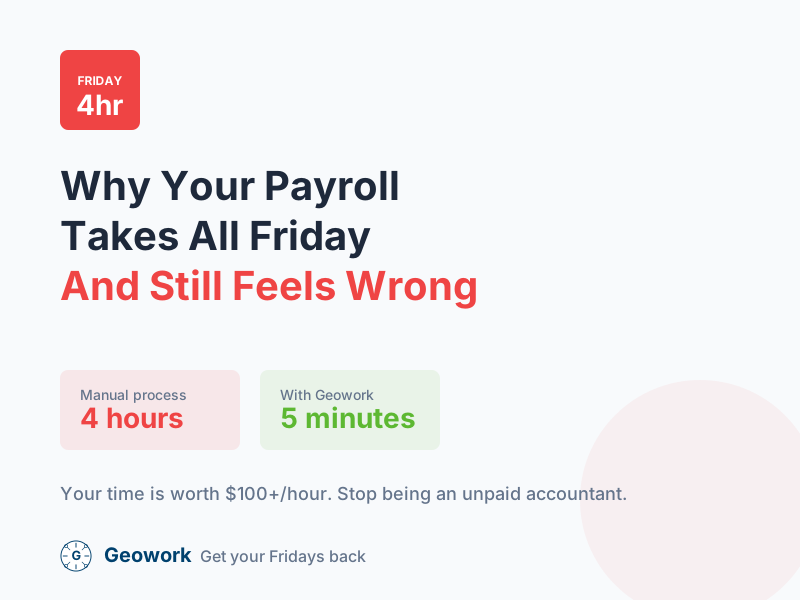
Your people actually showed up where they said they did. GPS check-ins, tied to geofenced job sites, mean the timesheet isn’t a debate anymore. Payroll reconciles itself because the location already told you who was where, for how long. We wrote about why your payroll takes all Friday — the gap between the timesheet and the truth is almost always where Friday afternoons disappear.
Your dispatcher sees the board, not the blur. When the emergency call comes in, the question “who’s closest and available?” has a real answer in two seconds, not a phone tree of three calls to crew leads.
Failed truck rolls become visible. The crew went to the address. The customer wasn’t home. Nobody told the office. You find out on Monday from an angry voicemail. Or — if location data is flowing through your system — you find out at 10:14 AM when the arrival ping happens and the job status doesn’t change for 20 minutes.
The warranty dispute has an answer. The customer says the crew was only on site for an hour. The records say four. Now there’s a map. We’ve seen how much this costs operators who can’t prove what actually happened; your guys say they were there is about exactly this — what it takes to end the dispute before it starts.
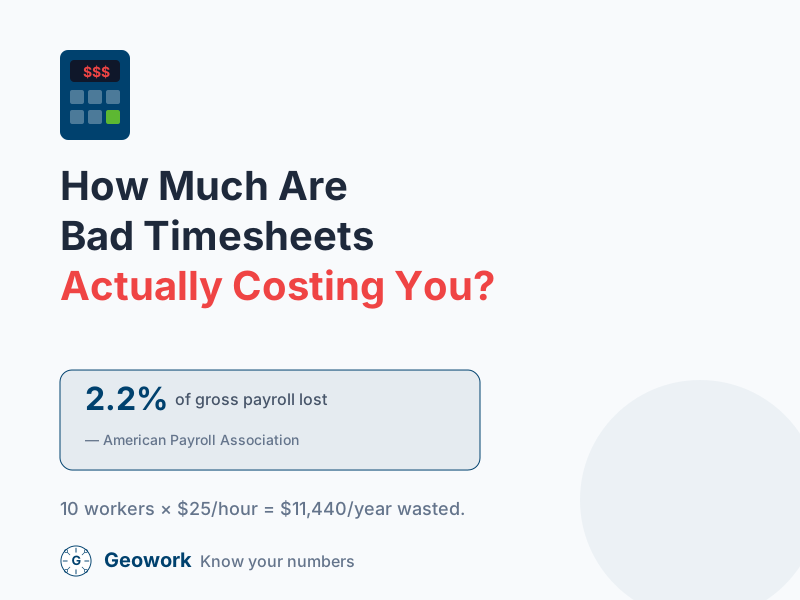
Your profitability-per-job is real. When you can tie actual time on site to actual job, you can finally tell which customers are making you money and which ones are costing you money. That’s the integrator doing its job. The cost of not knowing is bigger than most owner-operators realize until they run the numbers; we put one version of those numbers together in the $22,000 hole in your payroll .
None of this is theoretically possible. All of it is. The question has always been whether the technology was accessible to the shops that would benefit most.
The democratization problem
Dangermond has been explicit that AI’s role in the geospatial world is to augment human expertise, not replace it. Agents that guide professionals through workflows. Assistants that surface patterns a human analyst might miss. The goal is not a smaller workforce — it’s a more capable one.
That framing matters even more when you move it down-market. An owner-operator running a 20-person HVAC company isn’t going to hire a GIS analyst. They’re not going to stand up an ArcGIS deployment. They need the intelligence embedded in the tools they already use — dispatch, time tracking, messaging, reporting — in a way that makes their existing people better at their jobs.
That’s what “democratization of location intelligence” actually has to look like at the SMB level. Not a dashboard. Not a training program. A system where the geography is just there, quietly making the workflow smarter, without anyone having to think about it as “GIS.”
Why this moment is different
A few things are converging that weren’t true even five years ago. PostGIS and pgvector have made serious spatial analysis possible on commodity cloud infrastructure. Mobile devices in every tech’s pocket produce reliable, continuous location data. LLMs can translate “which crews are behind on hours this week?” into a real query against real data without a human writing SQL.
The ingredients for a location-intelligent operating system for small field businesses exist. Someone just has to assemble them in a form an owner-operator can buy on a Tuesday and deploy on a Wednesday.
The work
The intelligent world Dangermond describes won’t fully arrive when the biggest organizations adopt it. They already have. It arrives when the millions of small operators running the visible, physical economy can finally participate in the same intelligence their larger peers have enjoyed for decades.
Geography has always been the integrator. The technology to make it computable exists. The last mile is the tooling — and the pricing — that actually meets a 12-person crew where they work.
That’s what we’re building.
Geowork is a GPS-verified field operations platform built for construction GCs and home services operators running crews of 6 to 50. $69/mo + $15/worker, all features included. See the demo .
See the Demo
GPS-verified field operations for construction GCs and home services operators running crews of 6 to 50. $69/mo + $15/worker, all features included.