
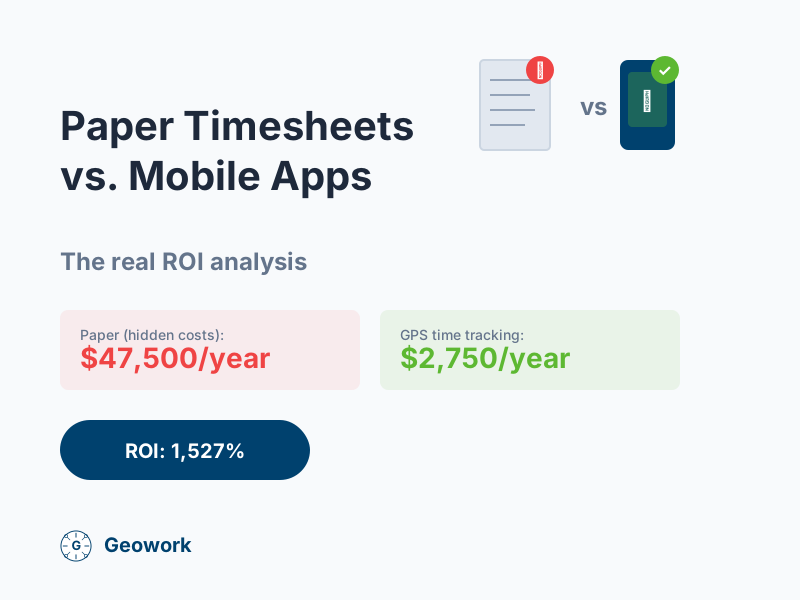
Paper timesheets have been around forever. They’re familiar, they’re cheap, and they don’t require any technology. So why are field service companies switching to mobile apps?
The answer is ROI. Paper timesheets cost more than you think, and mobile apps pay for themselves quickly. Here’s the real math.
The True Cost of Paper Timesheets
Paper timesheets seem free. A stack of forms costs a few dollars. But the real costs are hidden:
Administrative Time
Someone has to:
- Distribute timesheets to workers
- Collect them at the end of each week
- Decipher handwriting
- Check for errors and missing info
- Enter data into payroll manually
- File paper copies
Typical time spent: 3-5 hours per week for a 20-person crew.
Cost: At $25/hour admin rate, that’s $75-125/week or $3,900-6,500/year.
Error Costs
Paper timesheets are riddled with errors:
- Math mistakes: Workers add wrong, you pay wrong
- Rounding errors: “About 8 hours” isn’t accurate
- Missing entries: Forgot to write down a job
- Illegible writing: Is that a 7 or a 1?
Error rates: Paper timesheets commonly contain errors—rates vary by company, but manual processes inherently introduce mistakes in transcription, calculation, and data entry.
Cost: For a company with $500,000 in annual labor, a 3% error rate costs $15,000/year.
Time Theft
Paper timesheets make time theft easier:
- No verification of clock-in times
- Easy to round up hours
- Buddy punching is simple
Potential loss: Varies widely by company—some sources cite significant percentages of payroll, though hard numbers are difficult to verify. Even modest time inflation (a few minutes per day per worker) adds up across a year.
Lost Timesheets
Timesheets get lost, wet, torn, or thrown away.
- Replacement sheets require worker memory (inaccurate)
- Lost time = unbilled hours for service companies
- Compliance issues for government work
Total Paper Costs
For a 20-person field service company with $500,000 in labor:
| Cost Category | Annual Cost |
|---|---|
| Admin time | $5,000 |
| Error corrections | $15,000 |
| Time theft | $25,000 |
| Lost timesheets | $2,500 |
| Total | $47,500 |
Mobile App Costs
Now let’s look at mobile time tracking apps.
Software Cost
Most apps charge per user per month. Typical pricing:
- Budget apps: $5-8/user/month
- Mid-range apps: $8-12/user/month
- Premium apps: $12-20/user/month
For a 20-person crew at $10/user/month: $200/month or $2,400/year.
Some apps offer flat-rate pricing for larger teams.
Setup Time
Initial setup takes 2-4 hours:
- Creating accounts
- Adding workers
- Configuring job sites
- Testing the system
One-time cost: Maybe $100 in admin time.
Training
Workers need basic training on the app:
- 15-30 minutes for most people
- Show them how to clock in/out
- Explain GPS verification
Total training time: 5-10 hours for a 20-person crew.
Total App Costs (Year 1)
| Cost Category | Annual Cost |
|---|---|
| Software | $2,400 |
| Setup | $100 |
| Training | $250 |
| Total | $2,750 |
The ROI Calculation
Let’s compare paper vs. mobile apps:
Paper Timesheets
- Annual cost: $47,500
Mobile App
- Annual cost: $2,750
- Savings: $44,750
ROI
- Investment: $2,750
- Return: $44,750
- ROI: 1,527%
The app pays for itself in about 3 weeks.
Beyond the Numbers
ROI isn’t just about money. Mobile apps also provide:
GPS Verification
Every time entry is location-verified. You know workers were actually at the job site.
Real-Time Visibility
See who’s working right now, where they are, and what job they’re on.
Faster Invoicing
For service companies that bill by time, faster timesheet processing means faster invoicing and better cash flow.
Better Records
Digital records are searchable, sortable, and can’t get lost. Useful for audits, disputes, and compliance.
Worker Experience
Many workers adapt quickly to apps and appreciate:
- No forms to fill out
- No lost timesheets
- Easier to check their own hours
- Fewer payroll errors (they get paid correctly)
Some workers may initially resist change—proper communication and training help with adoption.
Common Objections
“My workers aren’t tech-savvy”
Modern time tracking apps are simple—one tap to clock in. If someone can use a smartphone, they can use the app.
Workers in their 50s and 60s adapt quickly because the app is easier than paper.
“What about workers without smartphones?”
According to Pew Research, about 91% of U.S. adults own a smartphone. For workers without one, most apps offer:
- Tablet kiosks at job sites
- Supervisor clock-in on behalf of workers
- Web-based time entry
“Paper is free”
Paper forms are cheap, but processing them isn’t. The $40,000+ in hidden costs dwarfs any software subscription.
“We’ve always done it this way”
Change is hard. But companies that switched 5 years ago wonder why they waited so long.
Making the Switch
Ready to move from paper to mobile? Here’s how:
Step 1: Calculate Your Current Costs
Use the formulas above to estimate what paper is really costing you.
Step 2: Try Free Trials
Most apps offer 14-day free trials. Test 2-3 options with a small crew.
Step 3: Start Small
Don’t switch everyone at once. Run paper and app side-by-side for one pay period to verify accuracy.
Step 4: Train and Roll Out
Train crews in small groups. Address questions immediately.
Step 5: Kill the Paper
Once you’re confident, stop accepting paper timesheets. Hybrid systems create confusion.
The Bottom Line
Paper timesheets cost far more than they appear. Between admin time, errors, and time theft, a 20-person crew might be losing $40,000+ annually.
Mobile time tracking apps cost a fraction of that and eliminate most of these losses. The ROI is massive—typically 10x or more.
If you’re still on paper, you’re leaving money on the table.
Ready to Switch to Mobile?
- Calculate your savings — See your potential ROI
- Request a demo — See mobile time tracking in action
- View pricing — Flat-rate options for growing teams
ROI estimates in this article are illustrative scenarios. The commonly cited time theft statistics are difficult to verify from primary sources. Smartphone ownership data from Pew Research Center (pewresearch.org). Your actual results will depend on your current processes.
Make the Switch Today
See how mobile time tracking pays for itself in weeks, not months.
Comments (0)
Be the first to leave a comment!
Leave a Comment