
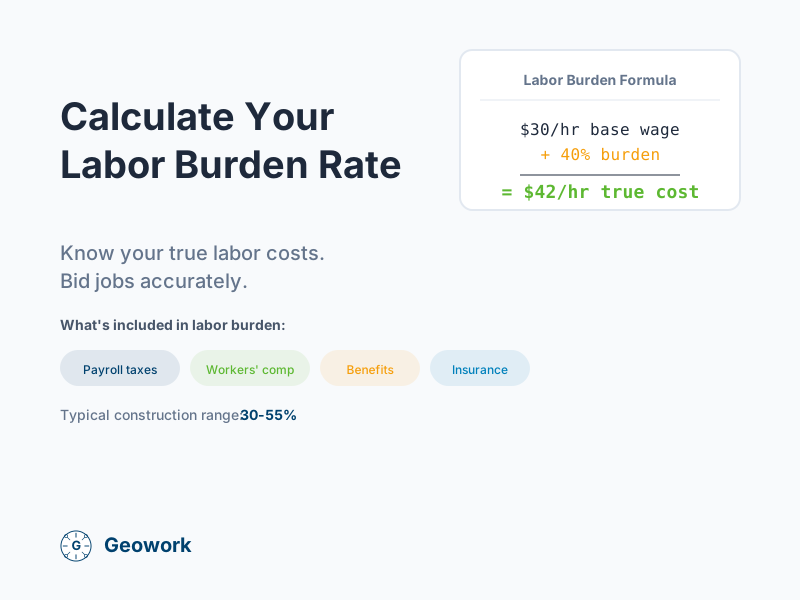
If you’re bidding construction jobs based on hourly wages alone, you’re losing money. Labor burden—the additional costs beyond wages—typically adds 30-55% to what you pay workers for most construction companies.
Understanding and calculating your true labor burden rate is essential for profitable bidding.
What is Labor Burden?
Labor burden is the total cost of employing a worker beyond their base wage. It includes:
- Employer taxes (Social Security, Medicare, unemployment)
- Insurance (workers’ comp, liability, health)
- Benefits (PTO, retirement, etc.)
- Equipment and tools
- Training and safety
When you pay a carpenter $30/hour, your actual cost might be $40-45/hour after burden.
The Labor Burden Formula
Total Labor Cost = Base Wage + Labor Burden
Labor Burden Rate = (Total Burden Costs ÷ Base Wage) × 100
Let’s break down each component.
Component 1: Employer Taxes
Taxes you pay on every payroll:
Social Security (FICA)
- Rate: 6.2% of wages
- Cap: $184,500 (2026—verify at ssa.gov/cola as this changes annually)
- Your cost for $30/hr worker: $1.86/hr
Medicare
- Rate: 1.45% of wages
- No cap
- Your cost for $30/hr worker: $0.44/hr
Federal Unemployment (FUTA)
- Rate: 6% on first $7,000 per employee
- Effectively 0.6% after state credit
- Your cost: ~$0.02/hr (averaged over year)
State Unemployment (SUTA)
- Rate: Varies by state and experience rating (1-8% typical)
- Wage base: Varies by state ($7,000-$50,000+)
- Your cost: $0.20-1.00/hr (varies significantly)
Total employer taxes: Approximately $2.50-3.50/hr for a $30/hr worker (8-12%)
Component 2: Workers’ Compensation Insurance
Workers’ comp rates vary dramatically by:
- Job classification: Roofers pay more than office workers
- State: California costs more than Texas
- Experience rating: Your claims history affects rates
Typical Construction Rates
| Classification | Rate per $100 payroll |
|---|---|
| Clerical | $0.20-0.50 |
| Carpentry | $8-15 |
| Electrical | $5-10 |
| Plumbing | $4-8 |
| Roofing | $15-40 |
| Concrete | $10-20 |
Calculating Workers’ Comp Cost
For a carpenter at $12/$100 in workers’ comp:
- Hourly wage: $30
- Daily wage: $240 (8 hours)
- Workers’ comp cost: $240 × 0.12 = $28.80/day
- Hourly burden: $3.60/hr
Workers’ comp: $2-10+/hr depending on trade
Component 3: Health Insurance
If you provide health insurance:
- Average employer cost: $700-1,000+/month per employee (based on KFF 2025 Employer Health Benefits Survey—single coverage averages around $700/month, family coverage significantly higher)
- Hourly equivalent: $4-6+/hr (assuming 173 hours/month)
Not all contractors provide health insurance. If you don’t, this is $0 in your burden rate.
Component 4: Other Benefits
Paid Time Off (PTO)
If you offer PTO:
- 2 weeks PTO = 4% burden (they get paid but don’t work)
- Hourly burden for $30/hr worker: $1.20/hr
Retirement Benefits
401(k) match or other retirement contributions:
- 3% match = $0.90/hr for $30/hr worker
- Higher matches increase this proportionally
Other Benefits
- Life insurance: $0.10-0.25/hr
- Disability insurance: $0.10-0.50/hr
- Training allowances: Varies
- Tool allowances: Varies
Component 5: Insurance & Overhead
General Liability Insurance
General liability is often calculated per $1,000 of payroll:
- Typical rate: $20-50 per $1,000 payroll
- For $30/hr worker: $0.60-1.50/hr
Supervision and Overhead
Some contractors include in labor burden:
- Foreman time (if not billed separately)
- Safety equipment
- Small tools
- Vehicles (if not billed separately)
The Complete Calculation
Let’s calculate burden for a $30/hour carpenter:
Example Breakdown
| Component | Cost/Hour | % of Wage |
|---|---|---|
| Social Security (6.2%) | $1.86 | 6.2% |
| Medicare (1.45%) | $0.44 | 1.5% |
| FUTA/SUTA (~2%) | $0.60 | 2.0% |
| Workers’ Comp (12%) | $3.60 | 12.0% |
| Health Insurance | $4.00 | 13.3% |
| PTO (2 weeks) | $1.20 | 4.0% |
| 401(k) match (3%) | $0.90 | 3.0% |
| General Liability | $1.00 | 3.3% |
| Total Burden | $13.60 | 45.3% |
Total loaded labor cost: $30 + $13.60 = $43.60/hr
Burden Rate Ranges
Typical burden rates by situation:
| Scenario | Burden Rate |
|---|---|
| Basic (W-2, minimal benefits) | 20-25% |
| Standard (W-2 + health insurance) | 35-45% |
| Full benefits package | 45-55% |
| Union with full benefits | 50-70% |
Note: 1099 independent contractors are not employees, so “labor burden” doesn’t apply in the same way—you pay them their contracted rate without employer taxes or benefits.
Using Burden Rate in Estimating
Job Cost Calculation
When estimating a job:
- Estimate labor hours: 100 hours of carpentry
- Apply base wage: 100 × $30 = $3,000
- Apply burden rate: $3,000 × 1.45 = $4,350
- Total labor cost: $4,350 (not $3,000)
If you bid $3,000 in labor, you’re losing money from day one.
Markup for Profit
Remember, burden covers costs—not profit. Your bid should be:
Total Labor Cost × Markup = Bid Amount
A typical 15-25% markup on labor covers overhead and profit.
Tracking Actual Burden
Your calculated burden rate is an estimate. Track actual costs:
Annual Review
Each year, calculate your actual burden:
- Total all burden costs for the year
- Total all base wages paid
- Divide: Actual Burden Rate = Burden Costs ÷ Base Wages
Compare to your estimated rate and adjust.
By Trade Classification
Different trades have different burdens (mostly due to workers’ comp). Calculate separately:
- Carpenter burden rate: 45%
- Electrician burden rate: 38%
- Laborer burden rate: 35%
Apply the right rate when estimating each trade.
Common Mistakes
Forgetting Burden Entirely
Some contractors bid with base wages only. They’re always surprised when jobs lose money.
Using Outdated Rates
Workers’ comp, taxes, and insurance change annually. Update your burden calculation yearly.
Ignoring Trade Differences
A single burden rate for all trades underestimates high-risk work and overestimates low-risk work.
Not Tracking Actual Costs
If your actual burden differs from your estimate, you’re mis-pricing jobs.
The Time Tracking Connection
Accurate time tracking supports burden calculation:
- Correct hour counts: Burden is applied to hours worked
- Trade classification: Apply the right burden rate
- Job costing: See actual labor costs per project
- True project profitability: Compare bids to reality
GPS time tracking ensures the hours you’re applying burden to are accurate.
Calculator Worksheet
Use this to calculate your burden rate:
Annual Costs
| Item | Annual Cost |
|---|---|
| Total Base Wages | $_______ |
| Social Security (6.2%) | $_______ |
| Medicare (1.45%) | $_______ |
| FUTA/SUTA | $_______ |
| Workers’ Comp | $_______ |
| Health Insurance | $_______ |
| PTO Cost | $_______ |
| Retirement Match | $_______ |
| General Liability | $_______ |
| Other Benefits | $_______ |
| Total Burden Costs | $_______ |
Burden Rate
Burden Rate = Total Burden Costs ÷ Total Base Wages × 100 = ____%
The Bottom Line
Labor burden adds 25-50% to base wages for most construction companies. Failing to account for it in your estimates means bidding jobs at a loss.
Calculate your true burden rate, update it annually, and apply it consistently. It’s the difference between profitable jobs and wondering where the money went.
Ready to Track Labor Costs Accurately?
- Calculate your savings — Interactive ROI calculator
- Request a demo — See GPS time tracking for job costing
- View pricing — Flat-rate options for growing teams
Labor burden rates vary by company, location, and benefits package. Tax rates and wage caps are updated annually. Consult with your accountant for calculations specific to your business.
Ready to See It in Action?
Join contractors who've already made the switch to GPS-verified time tracking.
Comments (0)
Be the first to leave a comment!
Leave a Comment